

close
Choose Your Site
Global
Social Media
Views: 0 Author: Site Editor Publish Time: 2026-04-22 Origin: Site


In corrosive chemical processing, filtration components are exposed to some of the most demanding service conditions in industry. Acids, alkalis, salt-rich solutions, oxidizing media, elevated temperatures, and abrasive slurries all place pressure on both the structural integrity and the functional precision of screening equipment. Under these conditions, conventional perforated or mesh-based elements may face challenges such as premature wear, clogging, unstable slot openings, or corrosion-related failure. This is why Wedge Wire Screen Cylinders for Corrosive Chemical Environments have become an important solution across many industrial systems. Their rigid structure, controlled slot profile, strong mechanical support, and adaptability in alloy selection make them especially valuable where process stability and service life matter as much as filtration accuracy.
Corrosive environments create a combination of risks that go far beyond simple liquid separation. In many chemical plants, screening equipment must withstand continuous exposure to reactive media while also handling pressure fluctuations, flow variation, and solids loading. A filter element may face chemical attack from the process stream on one side and mechanical stress from the operating system on the other.
This creates several design requirements at once:
· The screen must resist chemical degradation.
· The slot opening must remain stable over time.
· The structure must handle pressure and flow loads.
· The surface should minimize blockage and support cleaning.
· The product must be adaptable to different vessel and system configurations.
For this reason, standard solutions are often not enough. Wedge wire screen cylinders are widely selected because they offer a more engineered response to these combined demands.
A wedge wire screen cylinder is typically formed by welding profile wires around support rods to create a cylindrical filtering structure. The resulting slot is precise, continuous, and mechanically strong. One of its most important advantages is the wire profile itself. Because the wire is wedge-shaped rather than round, the opening can be designed to support efficient flow while reducing the chance of deep clogging.
The geometry of wedge wire helps create a narrow opening on the process side and a wider space behind it. This can improve discharge behavior and reduce the tendency of particles to become permanently trapped inside the screen.
Compared with some traditional filtration forms, wedge wire cylinders may offer:
· Better structural rigidity
· More accurate slot control
· Higher open area in many designs
· Improved cleanability
· Stronger resistance to deformation under working pressure
These features make them particularly suitable for filtration, screening, retention, separation, and dewatering tasks in aggressive industrial settings.
In corrosive duty, the performance of a screen cylinder depends heavily on the alloy selected. The screen geometry may be excellent, but if the material is not suitable for the media, failure can occur early. Chemical composition, concentration, temperature, flow velocity, and cleaning method all influence material choice.
For less severe chemical conditions, stainless steels may provide an acceptable balance between cost and corrosion resistance. In harsher media, higher-performance alloys may be more appropriate. The final decision usually depends on the exact chemical environment rather than on general assumptions.
Below is a simple comparison table to help illustrate typical evaluation factors.
Material Option | General Corrosion Resistance | Mechanical Strength | Typical Suitability in Chemical Use | Notes |
304 Stainless Steel | Moderate | Good | Mild, less aggressive environments | Often limited in stronger corrosive media |
316L Stainless Steel | Better than 304 | Good | Common chemical filtration applications | Improved resistance in many chloride-related conditions |
Duplex Stainless Steel | High | Very high | More demanding process conditions | Useful where strength and corrosion resistance are both important |
High-Nickel Alloys | Very high | High | Severe corrosive environments | Often selected for highly aggressive chemical service |
Special Alloy Options | Application-specific | Application-specific | Tailored process requirements | Chosen according to exact fluid and temperature profile |
In practice, material selection should be based on media analysis, operating conditions, and expected maintenance cycles. A well-designed cylinder in the wrong alloy will rarely deliver reliable long-term value.
Material is only one part of the equation. The actual performance of Wedge Wire Screen Cylinders for Corrosive Chemical Environments also depends on the relationship between slot opening, open area, and hydraulic behavior.
A narrower slot can improve retention of fine particles, but it may also increase pressure drop if not designed properly. A wider slot may support stronger flow but reduce separation precision. The right balance depends on the function of the cylinder within the system.
Slot opening
This determines what solids are retained or excluded. Precision matters because inconsistent openings can affect both product quality and process stability.
Open area
Higher open area can support improved flow and reduce resistance, but it must be balanced against mechanical strength.
Wire orientation
Depending on whether filtration is intended from outside to inside or inside to outside, wire orientation can be selected to support cleaning and solids release.
Cylinder diameter and length
These influence available screening area and installation compatibility within the housing or vessel.
Support rod spacing
This affects strength and shape retention, especially in larger-diameter cylinders or higher-pressure service.
This is why wedge wire solutions are rarely “one size fits all.” The best results come from matching the cylinder geometry to the actual process objective.
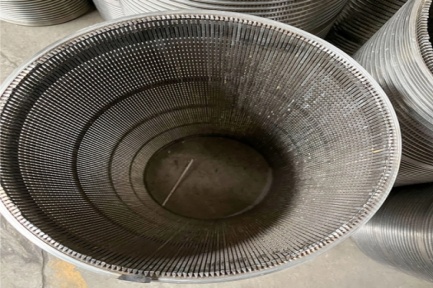
Chemical plants often choose wedge wire cylinders because they need durability and predictable operation over extended production cycles. The advantages become clearer when looking at real process priorities.
A properly designed wedge wire cylinder can maintain slot consistency even when exposed to demanding flow and chemical attack. This helps support more reliable separation performance over time.
The wedge-shaped profile often helps solids release more easily than flat or straight-sided openings. This supports longer operating intervals and more efficient cleaning.
In many systems, cleanability is just as important as initial filtration performance. Wedge wire cylinders can be integrated into systems that require backwashing, flushing, or periodic cleaning.
When the correct alloy and design parameters are selected, wedge wire cylinders may offer a longer useful life than less rigid screening forms in chemically aggressive applications.
These benefits matter because downtime in chemical processing is costly. Even a small improvement in maintenance interval or cleaning efficiency can have significant operational value.
The term industrial filtration for chemical processing covers a wide range of applications, and wedge wire cylinders are used in more than one role. Their suitability depends on whether the system needs solid-liquid separation, catalyst retention, pre-filtration, media support, or process stream screening.
Common application areas include:
· Chemical reactors and feed systems
· Acid and alkali handling lines
· Resin and polymer processing
· Solvent recovery systems
· Wastewater treatment in chemical plants
· Process water and wash water screening
· Solid recovery from corrosive liquid streams
· Protection of downstream pumps, nozzles, and valves
In some projects, wedge wire cylinders function as primary screening components. In others, they act as support elements, internal separators, or protective pre-filters that improve the performance of the overall system.
From our perspective, the value of Wedge Wire Screen Cylinders for Corrosive Chemical Environments lies in their ability to combine precision, strength, and adaptability in conditions where ordinary screening components may struggle. In chemical service, every detail matters: alloy selection, slot profile, welding consistency, flow direction, and installation fit all influence whether a cylinder becomes a durable process asset or a recurring maintenance problem. We believe that buyers should look beyond basic dimensions and pay closer attention to application matching, fabrication quality, and full life-cycle performance. At Anping Shuoqiao Trading Co., Ltd., we approach these products with that long-term view in mind. Rather than treating every project as a standard order, we recognize that corrosive media demand more careful material and design evaluation. For readers who want to learn more about wedge wire solutions, application matching, or custom screen cylinder options for chemical systems, we recommend exploring more information from Anping Shuoqiao Trading Co., Ltd. or contacting our team for a more detailed discussion based on actual operating conditions.
They combine structural strength with precise slot openings and can be produced in corrosion-resistant alloys suited to demanding chemical media. This helps improve reliability and service life in aggressive process conditions.
The process medium should be evaluated first, including chemical composition, concentration, temperature, pressure, and solids characteristics. These factors influence both alloy choice and cylinder design.
Yes. Their wedge-shaped wire profile is often designed to improve flow behavior and reduce the tendency of particles to become deeply trapped, which can support easier cleaning and longer operating periods.
Yes. Slot size, cylinder dimensions, end fittings, wire orientation, and material selection all need to match the actual system conditions. Customization often has a direct impact on performance and maintenance outcomes.


