

close
Choose Your Site
Global
Social Media
Views: 0 Author: Site Editor Publish Time: 2026-08-05 Origin: Site


Pumps drawing from rivers, ponds, reservoirs, or wells often face a simple but costly problem: debris reaches the intake before the equipment has a chance to handle it. Sand, weeds, leaves, and other solids can restrict flow, wear components, or jam moving parts, while an overly restrictive screen can create its own suction problems.
Intake screens help manage that balance by keeping damaging material out without unnecessarily limiting water entry. The sections ahead explain how slot size, screen area, placement, and maintenance affect debris control, pump protection, and reliable operation.
Not every particle suspended in source water represents the same risk. Leaves, weeds, twigs, algae mats, and other larger organic materials can collect around an intake or obstruct passages farther into the system. Fibrous material presents another problem because long strands can accumulate around narrow openings and rotating components, while sand and grit may pass through openings that are too large and expose downstream equipment to abrasive solids. Effective intake screens therefore need to address the debris actually present at the site rather than simply provide the smallest available opening.
Groundwater systems illustrate this point well. A well screen primarily controls sediment entry rather than purifying water in the broader treatment sense, and continuous-slot designs are widely used for that purpose. Surface-water installations face a wider mix of material, so vegetation, seasonal leaf fall, woody debris, algae, and changing water levels may become equally important design considerations. Where debris loading is severe, coarse protection may also be needed ahead of the finer screening surface.
Debris becomes a pump problem through two different paths. Some material passes through the screen and reaches downstream equipment, while other material remains on the screen surface and gradually reduces the available flow area. As that usable area shrinks, water must enter through fewer open passages, making suction conditions less favorable and increasing the importance of every remaining clear section of screen.
The result can be lower flow, repeated cleaning, unstable operation, or physical wear when abrasive particles reach pump components. Stainless-steel water-well screens designed for sand exclusion and resistance to sediment abrasion can help reduce this exposure in groundwater applications. A screen is therefore most valuable when it stops damaging solids before they become an internal pump-maintenance problem.

Slot selection begins with the source, not the product catalog. The useful approach is to identify the debris or sediment capable of damaging the pump, determine the particle range that should remain outside the system, and then choose an opening that provides that retention without unnecessary restriction. In groundwater applications, screen slot size is commonly selected with aquifer particle size and particle-size distribution in mind rather than relying on one universal value.
Continuous-slot wedge-wire construction is particularly relevant where sand control and water inflow must coexist. ShuoQiao stainless-steel water-well intake screens are available with different filtration precisions and use wedge-wire configurations intended to combine controlled sediment exclusion with substantial open area. These specifications illustrate why the opening should be matched to actual source conditions instead of choosing one nominal slot size for every installation.
Debris Condition | Screening Priority | Opening/Area Consideration |
Coarse leaves and vegetation | Prevent large-material entry | Adequate openings with ample surface area |
Sand-bearing groundwater | Limit abrasive sediment | Slot matched to sediment size distribution |
Fine suspended solids | Improve particle exclusion | Finer openings may require more screen area |
Heavy seasonal debris | Preserve intake capacity | Allow margin for partial surface blockage |
Fish-bearing surface water | Reduce entrainment and impingement | Coordinate opening size with effective area and velocity |
Effective screen area is the part of the submerged screening surface through which water can actually pass. A large-looking housing does not automatically provide a large effective area because support members, blocked sections, incomplete submergence, and accumulated debris can all reduce usable surface. This is why intake screens should be sized from required pump flow and usable open area rather than external dimensions alone.
Flow velocity at the screen face is directly connected to this area. Approach velocity depends on the relationship between intake flow and effective screen area, while screen porosity, slot dimensions, submerged area, and material also influence overall hydraulic performance. Where fish protection is required, these variables become especially important because excessive velocity near the intake may increase the risk of aquatic organisms being drawn toward the screen.
Practical sizing should also recognize that a screen operating in real water will not remain perfectly clean. If a design can deliver the required flow only while virtually every slot is open, moderate fouling can quickly change its hydraulic behavior. Providing appropriate surface area gives intake screens more tolerance for temporary debris accumulation and makes individual blocked regions less critical to total intake capacity.
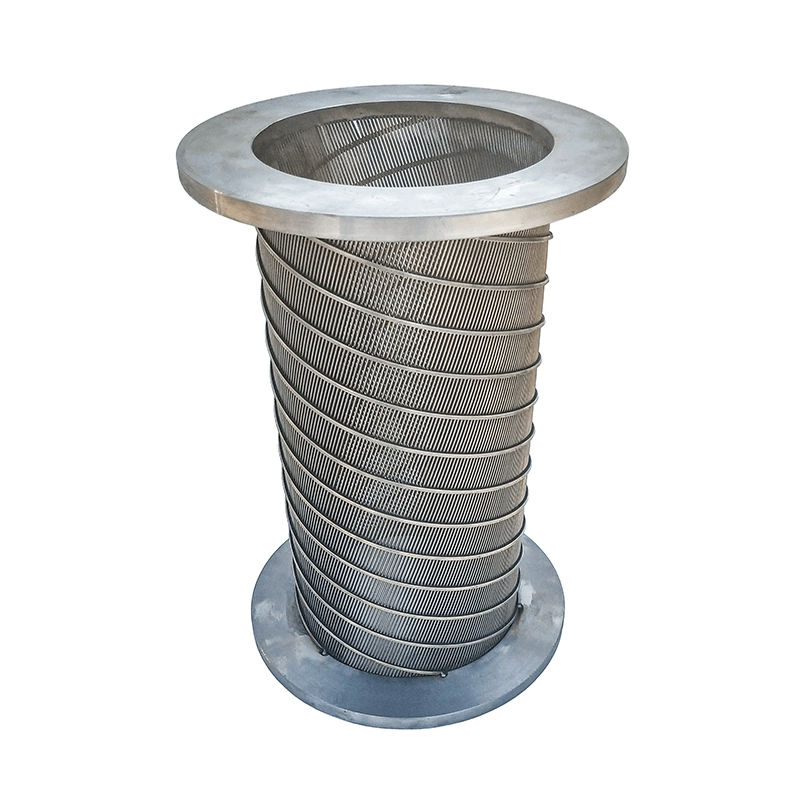
Opening geometry affects how easily material becomes lodged in the screening surface. Wedge-wire screens use long, controlled slots formed by shaped profile wires, and the passage typically becomes wider beyond the narrow screening point. This geometry allows the screening edge to control particle entry while giving material that reaches the opening less opportunity to become tightly wedged deeper inside the passage.
That geometry is useful when intake screens must maintain consistent openings while handling solids. ShuoQiao's Reverse Rolled Johnson Filter Element uses triangular profile wire joined to supporting ribs with controlled gap spacing, providing a practical example of a wedge-wire structure built around precise slots and a smooth screening surface. The relevant design principle is that slot shape and surface geometry influence how readily particles lodge in the screen and how easily accumulated material can be removed.
No screen shape can eliminate fouling in every water source. Sticky biological growth, fibrous vegetation, dense algae, or unusually heavy sediment can still cover the surface. Geometry should therefore be treated as one part of clogging control alongside screen area, positioning, and cleaning access.
Good placement can reduce the burden on the screen before any cleaning system is needed. An intake positioned directly in loose bottom sediment will face a different solids load from one located where surrounding water can reach the screen without continually disturbing the bed. Water-level variation matters as well because only the submerged and unobstructed portion contributes effectively to water intake.
Flowing water can provide another advantage. Where conditions permit, positioning the screen so ambient flow moves parallel to or across its face encourages sweeping movement instead of forcing debris directly into the surface. Appropriate orientation can help loose particles and aquatic organisms move along the screen rather than remain concentrated at one part of the intake.
Seasonal conditions should influence placement decisions too. A quiet intake location in one month may receive weeds, fallen leaves, algae, or flood-borne material at another time of year. For larger intake screens exposed to heavy woody debris or vegetation, a coarse trash rack can protect the finer screening surface before oversized material reaches it.
When water is withdrawn from fish-bearing sources, screening has a second function beyond pump protection. Appropriate openings reduce the chance of fish entering the intake, while hydraulic design controls how strongly aquatic life is drawn toward the screen. Two key risks are entrainment, where organisms pass into the intake, and impingement, where they become held against the screening surface.
Opening size alone cannot address both problems. Effective screen area influences approach velocity for a given withdrawal rate, while sweeping velocity can help carry fish and loose material along the face rather than directly toward it. Approach velocity, sweeping velocity, slot size, porosity, effective area, screen orientation, and material therefore need to work together when intake screens are used in fish-bearing waters.
Site conditions still determine the final criteria. Fish species, life stages, ambient current, water depth, and applicable regulations can alter the appropriate design. For that reason, a velocity or opening value used successfully at one intake should not automatically be copied to another.
A correctly sized intake screen can perform poorly once part of its surface becomes covered. Weeds may mat across one side, sediment may settle around the lower portion, and algae or other biological growth can slowly reduce porosity. Water then concentrates through the remaining clear openings, changing local flow conditions even if the pump continues delivering an apparently acceptable volume.
Several operating signs can indicate that usable area is declining. A noticeable reduction in pump flow, unstable suction conditions, visible debris mats, or progressively shorter cleaning intervals should prompt inspection of the screen rather than immediate assumptions about an internal pump fault. Sediment appearing downstream can point to a different problem, such as damaged wires, corrosion, deformation, or openings that have enlarged with service.
Maintaining effective area is especially important where aquatic protection depends on a controlled approach velocity. The required submerged and unobstructed screen area should remain available during operation instead of only meeting design conditions immediately after installation. Hydraulic performance at startup is therefore only the beginning; intake screens must preserve that performance while debris conditions change.
Cleaning frequency should follow what the water source is doing. A fixed schedule may be adequate during periods of light sediment loading but insufficient during algae growth, leaf fall, floods, or seasonal vegetation movement. Inspection plans are more useful when they respond to changing environmental conditions and track whether the screen remains submerged, open, undamaged, and free from excessive fouling.
The appropriate cleaning method depends on the intake screen and installation. Reverse flushing or backwashing can push accumulated material away from the surface where system design allows it, while water- or air-assisted cleaning can loosen deposits without requiring the screen to be removed. Manual removal may still be necessary for tangled vegetation or large objects, and every cleaning cycle provides an opportunity to inspect for damaged wires, enlarged slots, corrosion, deformation, and persistent deposits.
Cleaning should restore open area without damaging the filtration surface. A screen that is frequently scrubbed aggressively may remain visually clean yet gradually lose the slot precision that originally protected the pump. Biofouling deserves similar attention: it may not arrive as obvious floating debris, but progressive biological growth can still reduce usable openings and justify more frequent inspection. The practical goal is not to clean intake screens as often as possible, but to keep them hydraulically open and structurally sound throughout operation.
Effective Intake Screens protect pumps by balancing debris exclusion with reliable water flow. Slot size, open area, corrosion-resistant construction, screen placement, and timely cleaning all influence how well an intake handles sediment, vegetation, and other aquatic debris without creating unnecessary restriction.
For systems that require durable screening in groundwater or similar water-intake applications, Anping Shuoqiao Trading Co., Ltd. offers stainless-steel wedge-wire screens designed for controlled particle retention and steady water passage. Matching the screen to actual site conditions can reduce maintenance pressure and support more consistent pump operation.
A: Intake Screens block leaves, weeds, sand, and other debris before they enter the pump, helping reduce clogging, abrasive wear, and flow interruptions.
A: Yes. If the screen is undersized or heavily fouled, usable open area decreases, increasing flow resistance and potentially reducing water delivery to the pump.
A: Opening size should match the sediment or debris that needs exclusion while maintaining adequate open area. Finer openings can capture smaller particles but may clog faster.
A: Cleaning frequency depends on debris loading and operating conditions. Inspect the screen regularly and clean it when buildup begins reducing open area or affecting pump flow.
A: Typical signs include reduced pump flow, unstable suction, visible debris buildup, more frequent cleaning needs, and increased head loss across the intake.
A: Properly designed screens can reduce fish entrainment and impingement by combining suitable openings with sufficient screen area and controlled approach velocity near the intake.


