

close
Choose Your Site
Global
Social Media
Views: 0 Author: Site Editor Publish Time: 2026-09-15 Origin: Site


Choosing a water well screen slot size is a balancing exercise. Openings that are too large can admit sand and accelerate pump wear; openings that are too small can restrict entry, raise local velocity, and become more susceptible to blockage. The right size is not a default number taken from another project. It is selected from representative grain-size data, the completion method, the filter-pack design where used, and the well’s hydraulic objective. A sound selection process also considers screen geometry and the need to develop and maintain the well over time.
Use representative formation or filter-pack gradation data, not visual judgement alone.
Design the water well screen and filter pack as one sand-control system.
Evaluate open area and entrance velocity alongside nominal slot width.
Verify the selected slot, screen length, and construction on the final completion record.
Slot selection begins with samples taken from the target water-bearing interval. A sieve analysis shows how particle sizes are distributed, including the fine fraction that is most likely to move toward the well. The sample must be traceable to depth and understood in the context of drilling method, drilling fluid, and sample recovery. A mixed or washed-out sample can produce a misleading curve and an unsuitable screen decision.
For a natural-pack completion, the design may allow selected fine material to be removed during development so a stable coarser zone forms around the screen. For an artificial filter-pack completion, the screen slot is coordinated with the selected pack, which is itself selected to bridge and retain the formation material. These are different design paths; applying a rule from one to the other without checking the formation is a common cause of sand problems.
The slot dimension describes the opening width, but it does not fully define performance. The total open area, profile-wire geometry, screen diameter, screen length, hydraulic loading, and condition of the surrounding formation all influence how water enters the well. Continuous-slot designs distribute openings over a large area, while other screen types may have less open area and different flow paths. A continuous-slot water well screen should therefore be compared by the complete construction and installation context, not only a slot label.
Selection input | Question to answer | Decision risk if ignored |
|---|---|---|
Grain-size distribution | What fines and coarse fractions are present? | Sand production or premature plugging. |
Completion type | Natural pack or designed filter pack? | A slot rule may be applied to the wrong medium. |
Required discharge | How much water must enter at acceptable drawdown? | Excess entrance velocity and localized erosion. |
Screen geometry | What open area and slot profile are available? | Nominal slot width may mask a hydraulic restriction. |
Water chemistry | Is scaling, corrosion, or biofouling likely? | A workable initial slot may be difficult to maintain. |
In an engineered filter-pack well, the pack is the immediate material retained by the screen, while the pack must in turn control formation fines. Both interfaces matter. A well may produce sand if the pack is too coarse for the formation even when the screen retains the pack perfectly. Conversely, a slot can be too restrictive for the pack and reduce available open area. Treat the system as formation → pack → screen → well, not as a screen purchased separately.
Review the installation method as well. Pack segregation, bridging, inadequate tremie placement, or an off-center screen can cause uneven conditions around the pipe. The precision opening of a stainless steel wedge V-wire slot sieve is useful only when the surrounding materials are placed and developed correctly.
Wire-wrapped, continuous-slot screens are often chosen where controlled openings and higher open area are important. Their V-shaped profile can provide a widening flow path behind the narrow slot face, reducing the tendency for particles to lodge in the opening compared with a straight-sided cut. Slotted casing and perforated designs can be appropriate in different geologies or lower-demand conditions, but their open area, structural behavior, and available slot control should be evaluated honestly.
For projects requiring a welded profile-wire structure, a water well stainless steel wire screen is a relevant product reference. Buyers should still confirm outside diameter, slot width, wire and rod construction, section length, end connection, and material grade against their approved well design. Do not infer those details from a product category name.
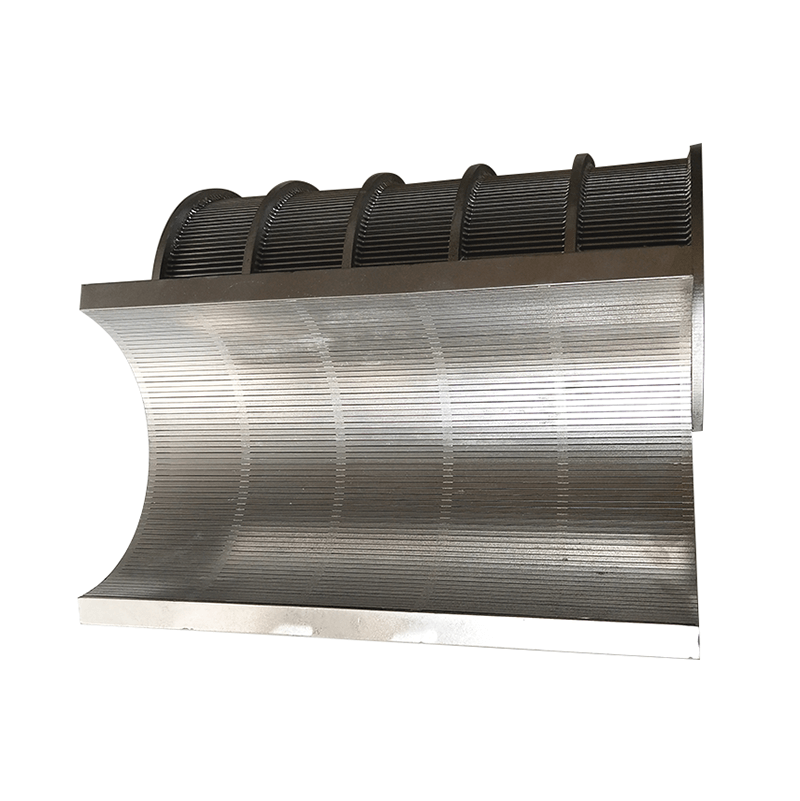
The screen needs enough effective open area to admit the design flow without excessive entrance velocity. A larger nominal slot may improve open area in some constructions, but it may also allow unacceptable solids to enter. A smaller slot may retain more material yet increase resistance and make scaling more consequential. The correct choice is the one that achieves sand control and workable hydraulics for the actual formation, not the largest opening that appears to improve flow.
Plan for development and future maintenance at the selection stage. If the source water is prone to scale or biological fouling, include that condition in the material and maintenance review. A wedge wire filter element represents the same principle of accurately welded continuous slots used across filtration applications, but a water-well design must account for groundwater chemistry and downhole access.
Before release, issue a specification that states the selected slot, tolerances, construction, material, screen dimensions, joints, and identification requirements. During installation, verify the actual sections against the tally and keep the sieve analysis, filter-pack information, and development results in the completion file. If the well later develops sand or loss of capacity, this evidence makes it possible to diagnose the issue rather than guess.
Anping Shuoqiao Trading Co., Ltd. lists wedge filter screens and water-well screen products within its manufacturing and sales range. That product context is useful for specifying a custom screen, but the final slot decision must come from the project’s formation data and well design.
The right water well screen slot size is chosen from data, not from a generic chart. Start with a representative sample, define the completion method, design the pack and screen together, then review open area, hydraulic loading, material compatibility, and installation controls. A flat wedge wire screen panel helps visualize precise profile-wire openings, while the finished well needs a slot decision proven against its own formation and operating conditions.
The key inputs are the formation’s grain-size distribution, the use of a natural or engineered filter pack, target flow, screen construction, and water chemistry.
No. Visual inspection cannot reliably show the fine fraction or grading characteristics that control sand movement. Use representative sampling and sieve analysis.
No. It may admit more sand and create downstream damage. Yield depends on the complete formation, pack, screen, and pumping design.
Open area affects how flow is distributed through the screen. Adequate effective area helps control local entrance velocity and supports development.
Changing it normally requires substantial rehabilitation, relining, or replacement. It is far more efficient to verify the selection before installation.


