

close
Choose Your Site
Global
Social Media


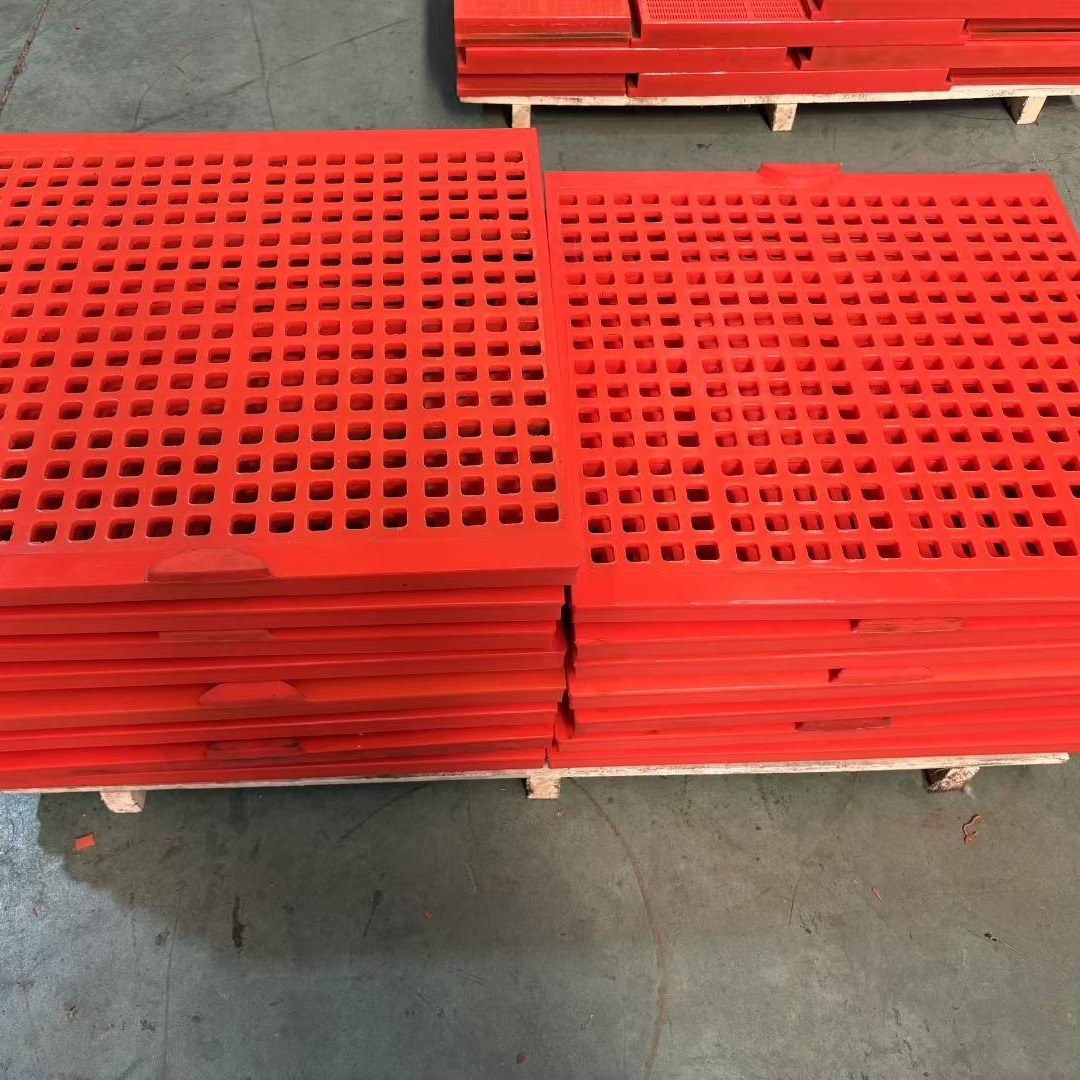


PU-1-1
SHUOQIAO
Unlike rubber mesh that hardens in low temperatures, it operates stably at -30°C to 80°C and achieves screening efficiency up to 95%. Customizable in thickness (3-15mm) and mesh size (1-100mm), it complies with ISO 14001 standards, ideal for mining, construction, and aggregate screening.
Superior Wear Resistance: Specialized polyurethane formula (with ceramic particles optional) reduces wear rate to <0.1g/cm² (ASTM D4060), 5x lower than steel mesh. In a limestone quarry, it lasted 12 months vs. 2 months for steel mesh.
Vibration Adaptability: Elastic modulus 10-20 MPa absorbs vibration energy, reducing noise by 15-20dB vs. steel mesh. The mesh’s self-cleaning property (elastic deformation during vibration) reduces clogging by 80% in wet screening.
Corrosion & Chemical Resistance: Resists acids (pH 4-12), alkalis, and oil contamination—no rust or degradation. Suitable for screening acidic mining tailings and oily construction waste.
Easy Installation & Replacement: Bolt-on or hook-on design fits most vibrating screens (e.g., Derrick, Metso). A 1m×2m mesh panel can be replaced in 10 minutes by 2 workers, 4x faster than steel mesh.
Mining Screening: A South African gold mine used 10mm PU mesh (shore 85A), screening gold ore (particle size 10-50mm) with 95% efficiency. Wear resistance reduced replacement costs by $60,000/year.
Construction Aggregate Screening: A Chinese concrete plant adopted 20mm PU mesh, screening crushed stone and reducing oversize particles (≥25mm) from 15% to 2%. The self-cleaning design eliminated manual clog removal.
Coal Preparation: An American coal mine used anti-static PU mesh (15mm mesh), screening raw coal and preventing dust explosions. The mesh withstood 3000rpm vibration and lasted 8 months.
Q: Which shore hardness fits different materials?
A: 65-75A for fragile materials (e.g., coal, glass) to avoid breakage; 80-90A for abrasive materials (e.g., limestone, iron ore) for wear resistance; 90-95A for heavy-duty screening (load >50kg/m²).
Q: Can it be used in wet screening (e.g., sand washing)?
A: Yes, choose water-resistant PU formula (hydrolysis resistance >1000 hours). The smooth surface prevents sand adhesion, and the elastic structure bounces off wet particles—screening efficiency remains ≥90% in wet conditions.
Q: What’s the maximum operating temperature?
A: Standard PU mesh up to 80°C; high-temperature grade up to 120°C (cost 2x standard). Avoid temperatures >120°C—causes material aging and strength loss (tensile strength drops by 50% at 150°C).
Q: How to repair small tears in the mesh?
A: Use PU repair adhesive (compatible with screen material) and reinforce with a PU patch (thickness same as mesh). For tears >50mm, replace the panel—repairing large tears reduces screening efficiency by 20%.


