

close
Choose Your Site
Global
Social Media
Views: 0 Author: Site Editor Publish Time: 2026-04-13 Origin: Site


Wastewater treatment depends on much more than pumps, tanks, and chemical dosing. At the center of many efficient systems is a filtration component that must handle solids separation, flow consistency, corrosion exposure, and long operating cycles without frequent failure. That is why wedge wire filter elements have become increasingly important in modern treatment processes. Whether used in municipal plants, industrial discharge systems, food processing wastewater lines, or pretreatment stages in reuse applications, these elements help operators manage suspended solids, protect downstream equipment, and maintain stable treatment performance. Their structure is simple in concept but highly effective in practice: a carefully engineered profile wire creates precise openings that allow liquid to pass while retaining unwanted particles. In wastewater environments, where clogging, abrasion, and variable loads are constant concerns, that design offers both mechanical strength and process reliability. For facilities seeking dependable filtration under demanding operating conditions, wedge wire filter elements are not just accessories; they are working components that directly influence treatment efficiency, maintenance frequency, and overall system stability.
Wastewater streams are rarely uniform. They may contain suspended solids, fibrous matter, grease, biological material, sludge particles, sand, or process residues. If these materials are not controlled at the right stage, they can reduce system efficiency and increase wear on pumps, membranes, nozzles, and downstream separation equipment.
Effective filtration in wastewater treatment must achieve several objectives at the same time:
· remove unwanted solids without excessive pressure loss
· maintain stable flow through continuous operation
· resist fouling and corrosion in harsh environments
· tolerate mechanical cleaning or backwashing
· support long service intervals
This is where wedge wire construction stands out. Because the slot opening is precisely formed and the surface profile helps reduce blockage, wedge wire filter elements are especially well suited for demanding liquid-solid separation applications.
Wedge wire filter elements are filtration components manufactured by welding shaped profile wires onto support rods. The spacing between the profile wires forms continuous slots, which act as the filtration opening. These elements may be produced in cylindrical, flat panel, basket, tube, or customized forms depending on the application.
Unlike perforated sheets or woven mesh, wedge wire structures offer a more controlled opening shape and stronger mechanical support. The slot is usually wider on one side and narrower on the filtering surface, which helps reduce particle wedging and improves cleaning performance.
In wastewater systems, wedge wire filter elements are commonly used in:
· intake screening
· rotary drum or basket filters
· sludge dewatering support structures
· resin trap systems
· nozzles and laterals
· sieve bends
· pretreatment units for industrial discharge
Their value lies not only in filtration accuracy but also in how they perform under continuous flow, variable solids loading, and chemically aggressive conditions.
The effectiveness of wedge wire elements comes from their geometry rather than from depth filtration media. The structure itself contributes to separation efficiency and operational reliability.
The wedge-shaped wire creates a smooth filtering surface with narrow, accurate slot openings. This allows operators to target specific particle retention levels while maintaining flow.
Because the slots run continuously across the filtering surface, open area can be relatively high compared with some conventional filter designs. Higher open area often means better hydraulic performance and lower energy demand.
The support rods reinforce the element and help it resist deformation under pressure, vibration, or cleaning cycles. This is particularly important in industrial wastewater treatment, where conditions may be more aggressive than in controlled clean-water systems.
The outwardly widening slot profile reduces the risk of particles becoming permanently trapped inside the opening. In many applications, this contributes to easier cleaning and more stable filtration over time.
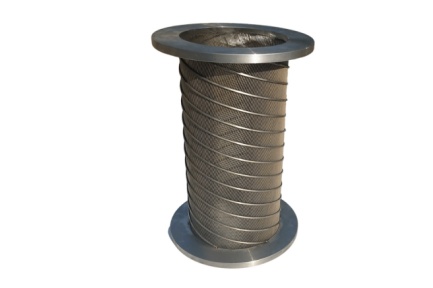
Wedge wire filter elements support wastewater treatment in several practical ways. Their role is not limited to simple particle screening; they also affect maintenance planning, process continuity, and equipment protection.
The most direct benefit is accurate and repeatable solids retention. In wastewater treatment, consistency matters. If the filtration opening is irregular or unstable, downstream performance may suffer. Wedge wire elements provide defined slot openings that support predictable separation.
Because of their relatively large open area and streamlined surface, wedge wire screens can maintain strong flow capacity while still removing solids. This is useful in systems where throughput and filtration must be balanced carefully.
Wastewater often contains sticky, fibrous, or irregular solids. Traditional media may blind quickly under such conditions. The geometry of wedge wire helps reduce surface blockage and supports more efficient cleaning.
In treatment plants, filtration elements may face pressure fluctuations, abrasive particles, vibration, and repeated wash cycles. Wedge wire construction provides good structural strength, which can extend service life.
Many wastewater systems rely on backwash, spray washing, or mechanical cleaning. Wedge wire elements are well suited for these methods because the slot structure is easier to clean than many tightly packed media materials.
When produced in appropriate stainless steel or other suitable alloys, wedge wire filter elements can perform well in challenging chemical environments, including municipal sewage, industrial effluent, and saline process water.
Different treatment stages place different demands on filtration. Wedge wire elements can be adapted accordingly.
Application Stage | Role of Wedge Wire Filter Elements | Main Benefit |
Preliminary screening | Remove larger suspended solids and debris | Protects downstream pumps and equipment |
Primary treatment support | Separate solids before settling or further treatment | Stabilizes process load |
Industrial pretreatment | Capture process particles, fibers, or residues | Improves compliance and equipment safety |
Sludge handling | Support drainage and solids separation | Aids dewatering efficiency |
Tertiary polishing support | Assist in final-stage filtration structures | Enhances water quality consistency |
Intake and reclaim systems | Prevent solids from entering reuse lines | Reduces fouling in sensitive units |
This wide range of uses explains why wedge wire products are common across both municipal and industrial wastewater treatment settings.
Wedge wire is not the only filtration solution available, but it offers a distinct set of advantages when the operating environment is demanding.
Perforated plate may provide strength, but it often has lower open area and less precise slot geometry. In fine filtration or high-flow applications, this can limit performance.
Woven mesh can be useful for certain fine separations, but it may be more vulnerable to deformation, clogging, or wear under harsh wastewater conditions. Wedge wire is generally more rigid and easier to clean mechanically.
Disposable media may work well in some closed systems, but wastewater treatment often requires reusable, robust components capable of long-term operation. Wedge wire elements are better aligned with continuous-duty industrial environments.
Rather than replacing every other option, wedge wire fills an important position where strength, precision, and maintainability must work together.
As wastewater treatment systems become more performance-driven, the value of dependable filtration components continues to rise. Wedge wire filter elements support wastewater treatment by combining strength, precision, cleanability, and flow efficiency in one engineered structure. They help remove solids more consistently, reduce clogging risk, protect downstream equipment, and support longer operational cycles in both municipal and industrial settings. Their usefulness extends across multiple treatment stages, from preliminary screening to sludge handling and specialized process filtration. At the same time, their performance is never determined by structure alone; material selection, slot design, cleaning method, and system integration all play essential roles. For operators and buyers, the real advantage of wedge wire lies in its ability to meet practical treatment demands over time rather than simply performing well on paper. A properly specified element can improve process reliability, simplify maintenance, and contribute to a more stable treatment system overall.
From our perspective as a company working with filtration products, the most effective solutions come from understanding the real operating environment instead of relying on standard assumptions. Different wastewater streams require different slot openings, materials, and structural designs, and those details make a measurable difference in long-term performance. At Anping Shuoqiao Trading Co., Ltd., we believe it is important to approach wedge wire applications with technical clarity and realistic process thinking. If you are evaluating filter elements for municipal treatment, industrial wastewater handling, or custom separation equipment, learning more about the right wedge wire configuration can help you make a more reliable decision. For more information about product options and application support, readers are welcome to contact Anping Shuoqiao Trading Co., Ltd.
Their precise slot openings, strong structure, high open area, and relatively low clogging tendency make them well suited for liquid-solid separation in demanding wastewater conditions.
No. They are also widely used in industrial wastewater systems, including food processing, chemical processing, mining, pulp and paper, and other sectors with solids-bearing effluent.
The correct slot size depends on the particle size distribution, flow rate, solids loading, and the purpose of the filtration stage. It should be selected based on actual process requirements rather than using the smallest possible opening.
Yes. In many applications, they are designed for repeated cleaning through backwashing, spray cleaning, brushing, or other maintenance methods, which supports longer service life.


